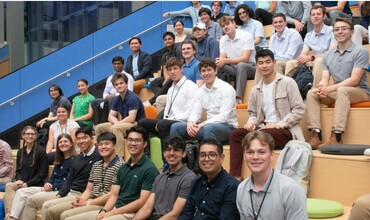
The Draper Scholars Program emphasizes empowering students in 16 key research areas to make the greatest impact. We encourage applicants to align their research with these topics.
Design Methodology
Draper has a very strong history of advanced electro-mechanical design of extremely high performance systems. We continue to explore state-of-the-art methods to advanced design in harsh environments.
We would be targeting PhD students for the development of novel approaches; and MS students for the application of existing approaches to specific problems of interest to Draper.
Technical Point of Contact
Research Interests
Generative Design
We are seeking novel ways to incorporate AI-driven generative design into the physical design process. The goal of this research would be to inject new options during ideation, promote innovative and creative solution development, and improve the overall efficiency of the design process in relevant engineering domains such as electro-mechanical systems, micro-electronics, and bio-engineering.
Draper frequently works on complex engineering design problems that require tradeoffs and optimization across many criteria and constraints. Our vision is that generative design algorithms trained using a combination of prior engineering solutions, natural forms, and even art could help engineers navigate these large trade spaces by automatically creating diverse design options that the engineer might not have otherwise considered. Coupled with engineering insight and other novel design methodologies, these solutions could have the potential to outperform traditionally designed systems across many variables (e.g. size, weight, power, materials, lifetime, etc.).
Novel Design Methodologies
Advanced methods of electro-mechanical design that challenge the current design paradigm are sought. Tools such as topology optimization and genetic algorithm optimization have been around for decades but, for a variety of reasons, rarely see use in the traditional design process.
Draper is interested in novel workflows that integrate tools like these with the traditional CAD process, rather than as specialized, rarely used add-ons. We seek to enable engineers to readily incorporate methods to more easily design structures that could, for example, take better advantage of the unique benefits of techniques like additive manufacturing and multi-material design that see limited use in finished products today.
Ultimately, the goal of this research is to arm designers with additional tools to achieve extreme performance, ultra-low SWaP, and ruggedized operation in harsh environments (e.g. long-duration space, hypersonic environments) to help us solve our Nation’s most challenging engineering problems.
Have Any Questions?
To learn more or stay up to date with our key areas, please fill out the below contact form.