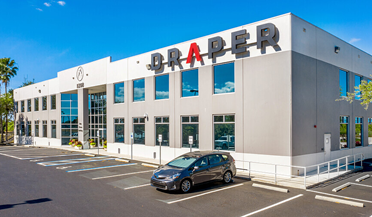
Draper Celebrates 10 Years of Operation and Excellence at Its Blue Heron Campus
When Draper opened the doors at its Blue Heron campus in St. Petersburg it had a lofty mission: create a space where engineers could move quickly from idea to prototype — and ultimately deliver critical capabilities for national security.
Today, that vision is thriving.
On April 6, Draper celebrated the 10-year anniversary of its Blue Heron campus, marking a decade of innovation, collaboration, and mission-driven work. Over the years, the site's 40,000-square-foot hub has been a place where our teams design, build, and test advanced systems supporting a range of important programs.
Built for Rapid Innovation
From the beginning, the Blue Heron campus was designed to support rapid development and hands-on engineering. The facility includes specialized labs and production spaces that allow teams to design, integrate, and test advanced technologies under one roof.
Among its capabilities are an unmanned systems integration lab, an Android Tactical Assault Kit (ATAK) software lab, and an Automated Test Equipment (ATE) production cell. The campus also houses dedicated radio frequency (RF) circuit and antenna design labs, enabling engineers to test and refine complex electronic systems.
These resources allow teams to quickly move from concept to working hardware — often in a fraction of the time traditional development cycles require.
Paulo Martins, Mechanism & Electromechanical Design, describes it this way: "Blue Heron is where rapid prototyping meets system-level engineering. From PCB to cable to 3D printed assembly, we deliver fully integrated hardware with speed, accuracy, and repeatability—seamless performance across every interface."
From Concept to Prototype
One of the defining strengths of the Blue Heron campus is its rapid prototyping capability. Engineers have access to a full suite of tools, including 3D printers, a full machine shop, and electronics assembly equipment that enable teams to design and prototype printed circuit boards (PCBs) entirely in-house.
"Unique missions demand unique solutions," says Nik Soulandros, Digital Signal Processing. "And Blue Heron's resources let us build mission-specific antennas capable of meeting the demands of America's warfighters — and get them downrange fast. Concept to prototype in a matter of hours."
The facility also features a near-field anechoic chamber and screen room for RF design and testing, providing a controlled environment to evaluate system performance. Combined with controlled-access areas and SCIF spaces, the campus can support multiple secure programs simultaneously.
This combination of advanced facilities and engineering expertise has helped the campus support key efforts in rapid prototyping, UAV fabrication, integration and testing, and work supporting U.S. Special Operations Command (SOCOM).
"At Blue Heron, especially the SOCOM business, you have the ability to see firsthand what our solutions can do for our customers," Soulandros explained. "To have people come in and have the end user say we used your item and it was really helpful, or it made our mission possible."
Looking Ahead
Over the past 10 years, the Blue Heron campus has played an important role advancing innovative solutions for some of the nation's most challenging technical problems. Just as importantly, it has built a strong and collaborative team culture that continues to drive its success.
As employees gathered on April 6 to celebrate this milestone, the anniversary provided an opportunity to celebrate the achievements of the past and the exciting work still ahead.