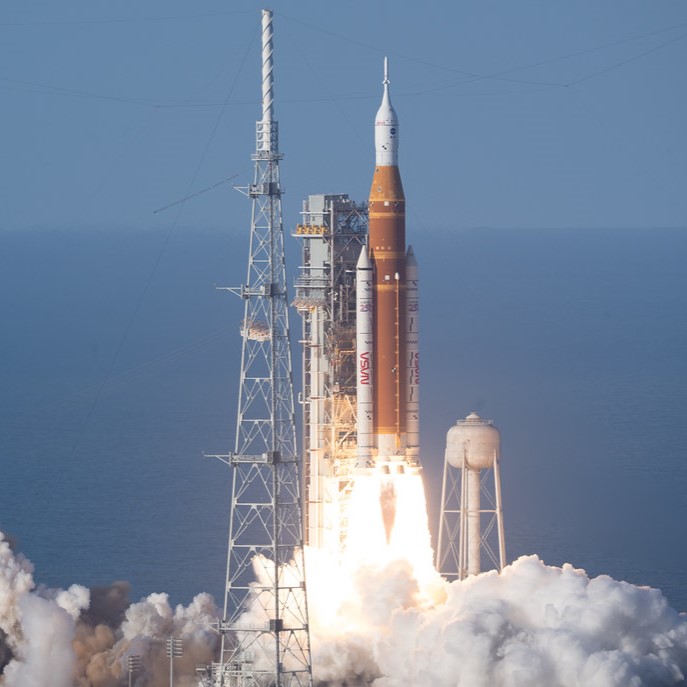
Draper-Developed Software Played a Key Role in NASA's Artemis II Mission
On April 1, the world watched as NASA launched Artemis II — the first human mission beyond Earth orbit in more than 50 years. During the 10-day mission, four astronauts completed two orbits around Earth before traveling nearly 5,000 miles beyond the far side of the Moon and almost 250,000 miles from Earth. And once again, Draper played an important role in the systems that made the mission possible.
Continuing a legacy that began with the Apollo program, Draper supported NASA and our industry partners in the development of both the Space Launch System (SLS) and the Orion Multi-Purpose Crew Vehicle. Our staff in Huntsville, Houston, Cambridge, and more were called on to solve some of the difficult technical challenges associated with flying the Artemis II crew around the Moon.
"In the space industry, it’s not every day that you see your work fly. Last week we had the honor of not only seeing our work fly, but to launch four crew members on their way to be the first people in over 50 years to fly to the Moon," said Alan Campbell, Director, Space Systems.
Draper staff led the NASA in-house Flight Software (FSW) development for the primary operation of the SLS vehicle, with significant contributions to the overall software and Guidance, Navigation, and Control (GN&C) software architecture. This work included development of Software-based Redundancy Management Systems (SBRMS) that supported the avionics architecture to ensure continuous operation if a failure occurs. Draper also provided its expertise on the Powered Explicit Guidance (PEG) algorithm used during the exo-atmospheric phase of the SLS ascent trajectory and for SLS orbital burns.
As the technical lead for the SLS command and data handling (C&DH) interface control document, Draper helped define the electrical, logical, and physical connections between the SLS's main computer and other subsystems. C&DH systems serve as the "brain" of a launch vehicle or satellite, collecting telemetry, managing command packets and processing instrument data.
Systems engineering support for the SLS Core Stage avionics was provided by Draper personnel with an emphasis on functional requirements (vs. hardware/mechanical requirements). Draper staff also performed on-console support in the SLS Engineering Support Center during SLS tanking, terminal countdown, and flight through Core Stage engine shutoff and disposal.
For Orion – named Integrity by its astronaut crew – Draper worked in partnership with NASA and Lockheed Martin to develop the spacecraft's GN&C systems. GN&C systems determine a vehicle's position and orientation (navigation), define its path to a target (guidance), and manage actuators to follow that path (control). These systems ensured precise trajectory execution, docking, and landing. The work included GN&C algorithm design and performance analysis, flight software implementation, software verification and validation, and operational engineering support throughout the mission from the Mission Evaluation Room (MER) in Houston.
Ten Draper employees staffed consoles in the Mission Evaluation Room (MER) throughout the 10-day mission in both primary and backup chair capacities. "NASA only selects those that they see as the best to sit in on these roles and it's a great testament to Draper's reputation and excellence that we have so many of our staff in these roles," said Matt Fritz with Draper's Space Exploration team. "This further reiterates not only our team's technical expertise when it comes to manned spaceflight but also the trust the customer has in Draper."
Finally, Draper contributed to the rendezvous, proximity, and operations (RPO) and docking software used by Orion. These systems were tested on day 2 of the mission as Orion successfully maneuvered around the Interim Cryogenic Propulsion Stage (ICPS).
Artemis II was the first of several NASA missions planned over the next three years. Artemis III will test docking and essential technologies with commercial landers from Blue Origin and/or SpaceX in a low-Earth orbit. If all goes well, Artemis IV will make the program's first lunar landing near the moon's south pole in late 2028.