Draper's LEAP Valve Demonstrates Spontaneous "Growth" in Preclinical Studies
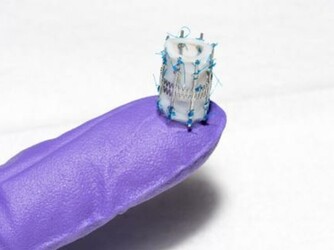
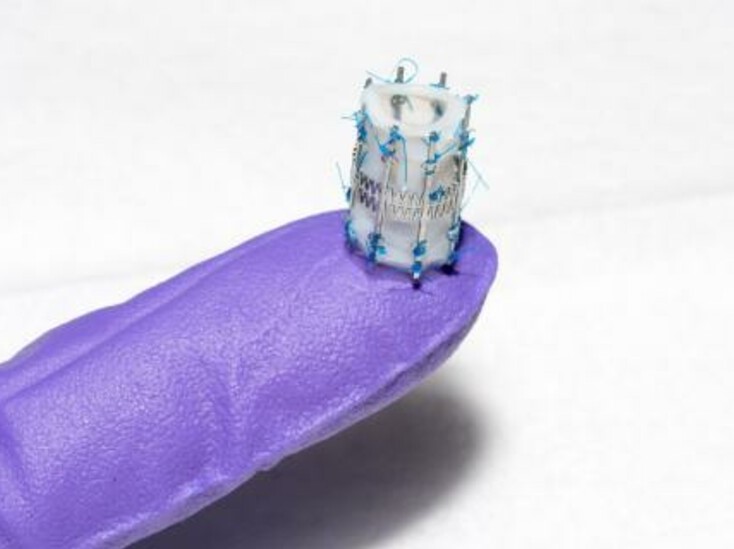
CAMBRIDGE, Mass. – The preclinical feasibility of Draper's Low-force Expanding/ Adaptable Pediatric (LEAP™) Valve is described in a research paper recently published in Science Advances. The LEAP Valve is a pediatric heart valve designed to "grow" spontaneously with infants and young children, reducing the need for related surgeries and invasive procedures.
"The initial results represent an important first step towards a growth-adaptive device that can eliminate at least one surgical replacement of current commercial implants or between one and three transcatheter procedures for balloon-expandable valves implanted in infants and young children," said Corin Williams, a biomedical engineer at Draper who leads the development team.
The LEAP Valve utilizes a unique stent design that acts like a low-force spring. By building these spring structures into the stent design, the whole device can spontaneously adapt diameter in the range of 7-14 mm. The force required to keep the stent in a compressed state upon implantation was determined by studying the mechanical properties of pulmonary artery tissue. This enables the spring to be compressed and then expand as the child grows without damaging the surrounding tissues.
The feasibility tests were conducted using rapidly growing piglets as a model for pediatric patients. At implantation, the LEAP Valve was constrained to the appropriate small diameter (~8-9 mm, similar to human infants) and demonstrated good valve function. The valves were examined at one-week intervals spanning two to six weeks post-implantation, showing proportional expansion with growth and reaching 13 mm diameter (50% increase) after six weeks, or roughly the equivalent valve diameter of a four- to six-year-old child.
The research paper published in Science Advances describes the device design and its preclinical testing results. The paper, "Design and Preclinical Feasibility of a Pediatric Heart Valve Stent that Spontaneously Adapts to Growth via a Spring Mechanism," was co-authored by: Draper's Giselle Ventura, James S. Malloy, Ian McGinty, David W. Sutherland Jr., Baturalp Arslan, Daniel F. King, David J. Carter, and Corin Williams; Masaki Kajimoto, Lyubomyr Bohuta, Kevin A. Charette, Kyle Bilodeau, Michael A. Portman from the Seattle Children's Research Institute; Mossab Saeed, Gianna Dafflisio, Shannen B. Kizilski, Peter E. Hammer, and Sitaram M. Emani from Boston Children's Hospital; and John P. Carney of the University of Minnesota, Experimental Surgical Services Laboratory.
This work was supported by the U.S. Army Medical Research Acquisition Activity, through the program, "Growth-Adaptive Pediatric Heart Valves: Addressing a Critical Unmet Need for Infants and Young Children That Saves Lives and Reduces Surgeries," under award number W81XWH2010295. Opinions, interpretations, conclusions and recommendations are those of the authors and are not necessarily endorsed by the Department of Defense.
In conducting research using animals, the investigators adhered to the laws of the United States and regulations of the Department of Agriculture.
About Draper
Draper is a non-profit research, development, and manufacturing company that solves some of the nation’s most important challenges. With more than 2,500 employees working in collaboration across 12 locations, Draper delivers transformative, mission-driven solutions that successfully meet our customers’ requirements. These efforts focus on four critical mission areas: Strategic Systems, Space Systems, Electronic Systems, and Biotechnology Systems. To extend our legacy into the future, the Draper Scholars program engages with the next generation of innovators while DraperSPARX™ seeks to partner with startups and small businesses that can further our mission. To learn more about Draper, visit www.draper.com. Follow Draper on Linked In and Instagram.
Released March 10, 2026